
Blooming
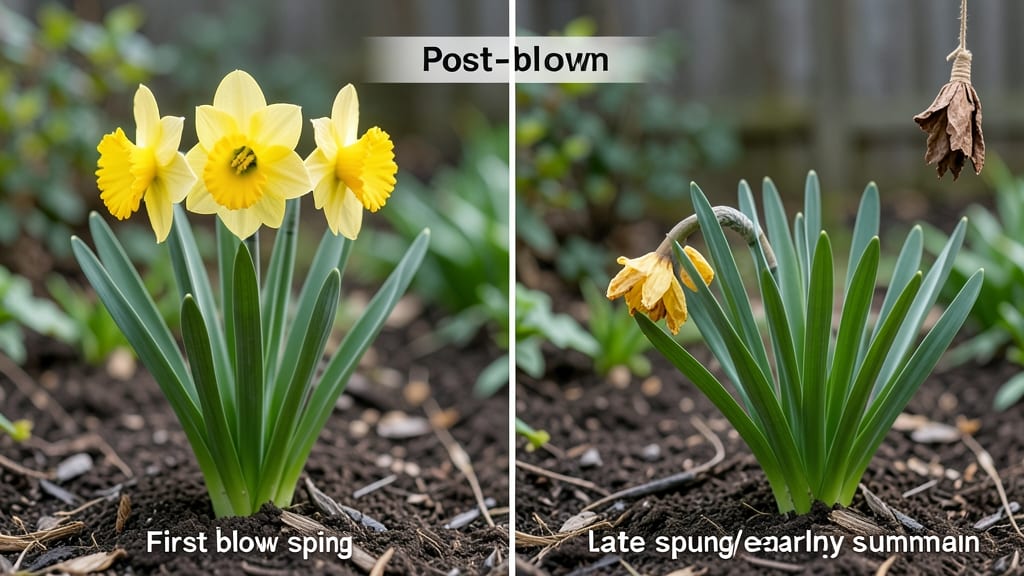
Daffodils bloom more than once when planted in well-drained soil and maintained properly, though their primary show happens in spring. Most varieties may produce smaller fall blooms, while Narcissus jonquilla and Narcissus tazetta often deliver more consistent reblooming under ideal growing conditions.
Most daffodils store energy in their bulbs during the growing season, allowing them to push out new flowers after their spring peak. 🌱 The key difference between varieties lies in their bulb strength and energy reserves—some types like Narcissus jonquilla (polyanthus daffodil) are particularly efficient at storing and redistributing nutrients.
Climate plays a role too: cooler fall temperatures often trigger secondary blooms, while hot summers can exhaust the plant's energy reserves.
The two standout rebloomers—Narcissus jonquilla and Narcissus tazetta—typically produce smaller but more frequent flowers throughout the growing season. These varieties have evolved with stronger root systems that can sustain multiple bloom cycles.
For gardeners, this means you might see clusters of smaller blooms in late summer or early fall, rather than just the dramatic spring display you're used to.
💡 In This Article
- Understanding Daffodil Bloom Cycles and Growth Habits
- How to Encourage Repeated Daffodil Blooms
Understanding daffodil bloom cycles and growth habits
Daffodils rely on a clever biological strategy to produce multiple blooms: their bulbs act as energy storage units, converting sunlight into carbohydrates during the growing season. This stored energy fuels both the dramatic spring display and potential secondary blooms later in the year.
The process begins when the plant enters dormancy after spring flowering—its leaves continue photosynthesizing for 6-8 weeks even after the blooms fade, replenishing the bulb's reserves. This is why you should never cut back daffodil foliage too soon—it's their secret weapon for reblooming!
The timing of secondary blooms depends on the variety and climate. Most daffodils produce smaller, less showy flowers in late summer or early fall, triggered by cooler temperatures and shorter daylight hours.
For example, Narcissus jonquilla often blooms twice—first in spring with large, fragrant flowers, then again in late summer with clusters of smaller blooms. Meanwhile, Narcissus tazetta (paperwhite daffodil) may produce multiple bloom cycles throughout the season in Mediterranean climates, where mild winters prevent full dormancy.
Soil conditions dramatically affect reblooming potential. Daffodils thrive in well-drained soil with a pH between 6.0-7.0, which prevents bulb rot while allowing optimal nutrient uptake. Heavy clay soils or waterlogged conditions stress the plant, diverting energy away from flower production.
The root system plays a crucial role too—mature bulbs with extensive root networks can sustain multiple blooms, while younger plants may conserve energy for bulb growth rather than flowering. This is why established daffodils (3+ years old) often show better reblooming habits than newly planted ones.
Climate variations create another layer of complexity. In regions with hot, dry summers, daffodils may skip secondary blooms entirely as they prioritize survival over reproduction. Conversely, areas with cool, moist summers (like the Pacific Northwest) often see reliable fall blooms.
Even within the same species, individual plants may behave differently—some Narcissus poeticus (poet's daffodil) plants bloom annually, while others take a year off to recharge their bulbs.
What most gardeners don't realize is that daffodil blooms actually follow a three-stage energy cycle: spring flowering, foliage growth for energy storage, and potential fall reblooming. The plant's ability to complete this cycle depends on three factors: bulb maturity, environmental conditions, and proper care.
For instance, a 6-inch diameter bulb (mature size) can produce 3-5 flowers per stem in spring, while the same bulb might only manage 1-2 smaller flowers in fall—this is nature's way of conserving energy for the next season.
Consider this comparison: Narcissus jonquilla produces 10-20 small flowers per stem in its secondary bloom, while Narcissus pseudonarcissus (common daffodil) might only manage 1-2 larger flowers in fall. The trade-off is clear—smaller blooms mean more flowers, while larger blooms require more energy.
This biological compromise explains why some daffodils appear to "skip" years—they're actually prioritizing bulb health over immediate flowering.