
Blooming
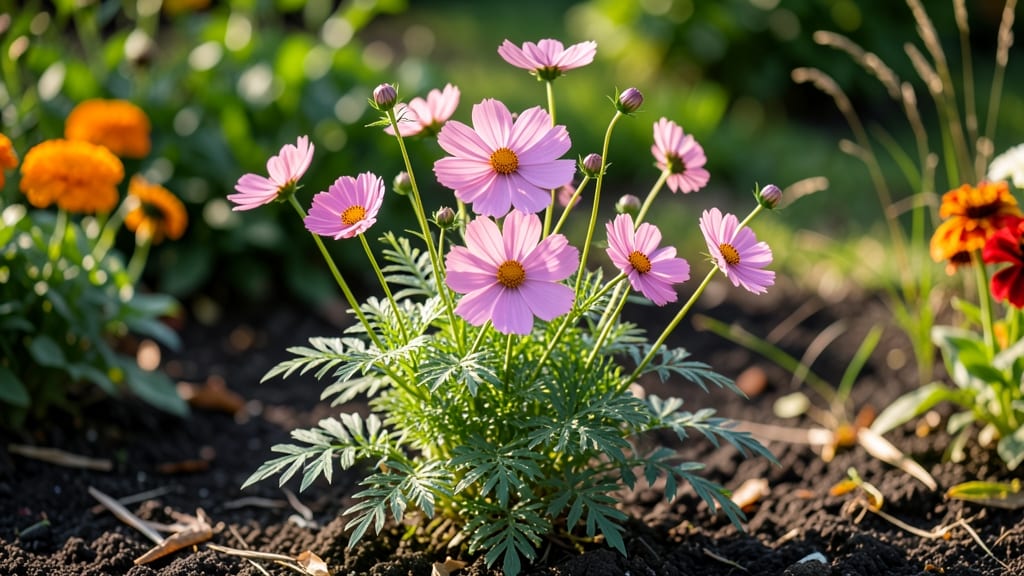
Cosmos do not bloom all summer continuously unless they are reblooming varieties like ‘Sensation’ or ‘Sea Shells’, which require deadheading and proper care to extend flowering into late fall with consistent deadheading and adequate watering.
Most cosmos varieties produce a single flush of flowers in early summer, then focus on seed production. 🌸 Reblooming types like ‘Sensation’ or ‘Sea Shells’ break this cycle by continuously producing buds when you remove spent blooms—a process called deadheading.
This encourages the plant to redirect energy into new flowers instead of seeds, which is why these varieties can keep blooming well into autumn. The key is staying consistent with care, especially during heatwaves when plants need extra water to support their extended flowering.
What many gardeners don’t realize is that even reblooming cosmos need proper soil fertility to perform their best. 🌿 A balanced fertilizer applied every 4-6 weeks helps sustain their energy levels, while mulching keeps roots cool and retains moisture.
I’ve found that pinching back leggy stems in early summer also promotes bushier growth, which translates to more flowers later in the season.
💡 In This Article
- Why Some Cosmos Bloom Longer Than Others
- Best Practices for Prolonging Cosmos Blooms
Why some cosmos bloom longer than others
Cosmos plants follow a natural biological cycle where their primary goal after flowering is seed production. Most annual varieties—like the classic 'Bright Lights' or 'Sonata'—produce a single burst of blooms in early summer, then shift their energy to developing seeds.
This is an evolutionary survival strategy: once flowers fade, the plant focuses on creating the next generation. However, reblooming cosmos like 'Sensation' or 'Sea Shells' have been selectively bred to break this cycle. Their genetic makeup allows them to produce flowers continuously when you intervene by removing spent blooms.
The key mechanism here is a process called apical dominance, where the plant's growth hormones concentrate at the tips of stems. When you remove a spent flower (deadheading), you're essentially telling the plant to redirect its energy from seed production to new buds forming along the stem.
This works because cosmos are indeterminate growers, meaning they produce flowers along their entire length rather than just at the tips. Without deadheading, these plants would stop flowering within 4-6 weeks as they prioritize seed development over new blooms.
Temperature plays a surprising role in this process. Cosmos thrive in warm climates (USDA zones 3-11), but their blooming patterns shift with seasonal changes. During heatwaves above 90°F, many varieties slow down or even stop flowering as a survival mechanism—they conserve water and energy.
However, reblooming types can recover quickly when temperatures drop below 85°F and you maintain consistent care. The contrast between day and night temperatures also matters: larger temperature swings (like 15°F differences) can actually trigger more robust flowering in some varieties.
Another factor is light exposure. Cosmos need full sun (6-8 hours daily) to produce their signature vibrant blooms, but too much intense afternoon sun in hot climates can cause flower buds to abort before opening. This is why morning sun with afternoon shade works better in regions like the Southwest.
The plant's internal clock (circadian rhythm) also influences blooming—cosmos typically flower in the morning when temperatures are cooler, which is why deadheading in the late afternoon gives buds time to form before nightfall.
Let's compare two popular varieties to see the difference: 'Bright Lights' (non-reblooming) produces flowers for about 4-6 weeks in early summer, then focuses on seeds. In contrast, 'Sensation Mix' can keep blooming for 3-4 months with proper deadheading.
The difference comes down to selective breeding—reblooming types have been developed to have shorter internodes (spaces between leaves) and more lateral buds, which means more potential flower sites along each stem.
What most gardeners miss is how soil fertility affects this cycle. Cosmos aren't heavy feeders, but they do respond well to balanced fertilizer (10-10-10) applied every 4-6 weeks during the growing season.
The nitrogen in fertilizer supports leafy growth that provides energy for continuous flowering, while phosphorus promotes root development to sustain the plant through extended blooming periods. Without proper nutrition, even reblooming varieties will eventually taper off as they exhaust their energy reserves.