
Blooming
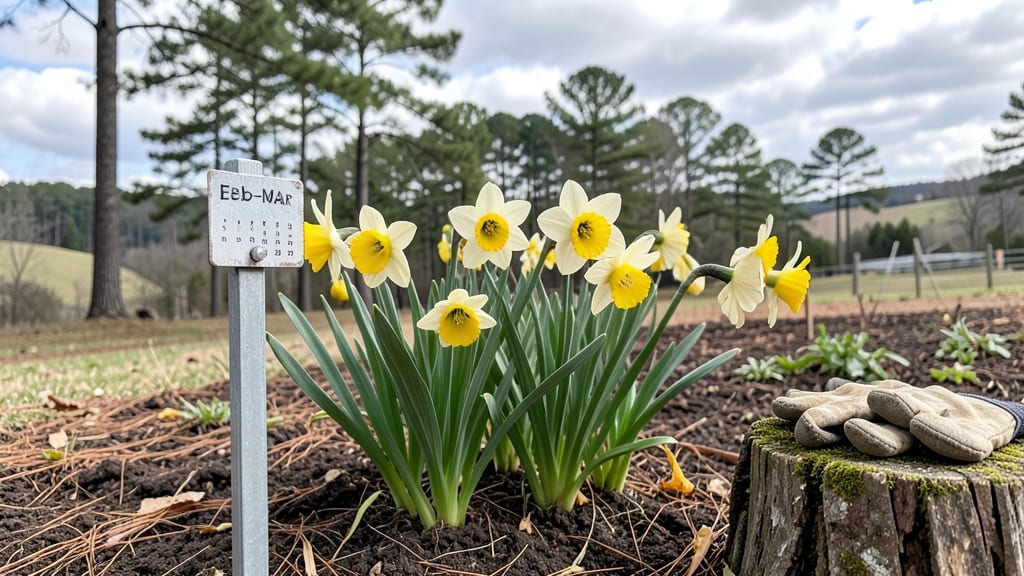
Daffodils in Georgia bloom between late January and early April, with early varieties like Jonquil appearing in late winter and later types such as Ice Follies showing up in March or April, depending on local climate variations and elevation.
Georgia's mild winters and varied elevations create a perfect stage for daffodils, with blooms often starting earlier in coastal areas like Savannah and stretching later in the Piedmont region. 🌸 The key factor is chilling hours—most varieties need 10-15 weeks below 40°F to trigger flowering, which explains why mountain areas like Dahlonega may see delayed blooms.
I've noticed that well-drained soil with added compost can push blooms forward by 1-2 weeks in Georgia's clay-heavy soils.
For gardeners, timing is everything—planting in October or November gives bulbs enough time to establish roots before winter, while spring-planted bulbs often bloom later or more sparsely. Mulching with 3-4 inches of straw after planting helps regulate soil temperature, which can be crucial during Georgia's unpredictable late-winter weather patterns.
💡 In This Article
- Georgia’s Daffodil Bloom Timeline by Variety
- Optimizing Daffodil Blooms in Georgia’s Climate
Georgia’s daffodil bloom timeline by variety
Georgia’s daffodil blooms unfold in a stunning progression, with early varieties like Jonquil and Tête-à-Tête pushing through the soil as early as late January in warmer coastal areas.
These varieties thrive in Georgia’s hardiness zones 7b-8a, where mild winters provide just enough chilling hours (10-12 weeks below 40°F) to trigger flowering. In contrast, later bloomers such as Ice Follies and Dutch Master typically appear in March, often lingering until early April in the Piedmont region.
The elevation plays a critical role—coastal areas like Savannah may see daffodils bloom 2-3 weeks earlier than inland cities like Athens or Macon.
This is because coastal regions experience milder winters with fewer frost days, while higher elevations in North Georgia (like zone 6b) may delay blooms until late March due to colder temperatures and longer chilling periods.
For example, a Jonquil planted in Savannah might bloom by early February, while the same variety in Dahlonega could wait until mid-March.
What’s fascinating is how daffodil varieties categorize into bloom waves. Early bloomers like Jonquil (yellow, fragrant) and Tête-à-Tête (miniature, white) dominate January-February, while mid-season varieties such as Ice Follies (white with yellow centers) and Dutch Master (deep yellow) peak in March.
These distinctions are tied to their vernalization requirements—the biological process where bulbs need cold exposure to flower. Coastal areas often meet these needs faster, while inland regions require more patience.
Gardeners in Georgia can strategically plant a mix of varieties to extend their bloom season. For instance, pairing Jonquil (early) with Ice Follies (mid-season) creates a 6-8 week display of color.
The key is understanding each variety’s chilling needs—most daffodils need 10-15 weeks below 40°F, but some, like Paperwhite (a forced variety), can bloom without chilling. This makes them ideal for indoor winter displays in Georgia’s colder months.
One surprising factor is how soil temperature affects blooming. In Georgia’s clay-heavy soils, which can retain heat, daffodils may bloom earlier than expected. However, if the soil stays too warm (above 60°F), bulbs can become dormant and skip flowering entirely.
This is why well-drained, slightly sandy soil is ideal—it allows roots to establish without overheating. Mulching with 3-4 inches of straw helps regulate these temperatures, especially in late winter.
For those in North Georgia, late frosts can be a challenge. Varieties like Jonquil, which bloom early, are more vulnerable to frost damage. Using frost cloths or planting near heat-retaining structures (like brick walls) can protect blooms until temperatures stabilize.
In contrast, later varieties like Ice Follies are hardier and can withstand cooler spring nights, making them a safer bet for gardeners in zone 6b.