
Blooming
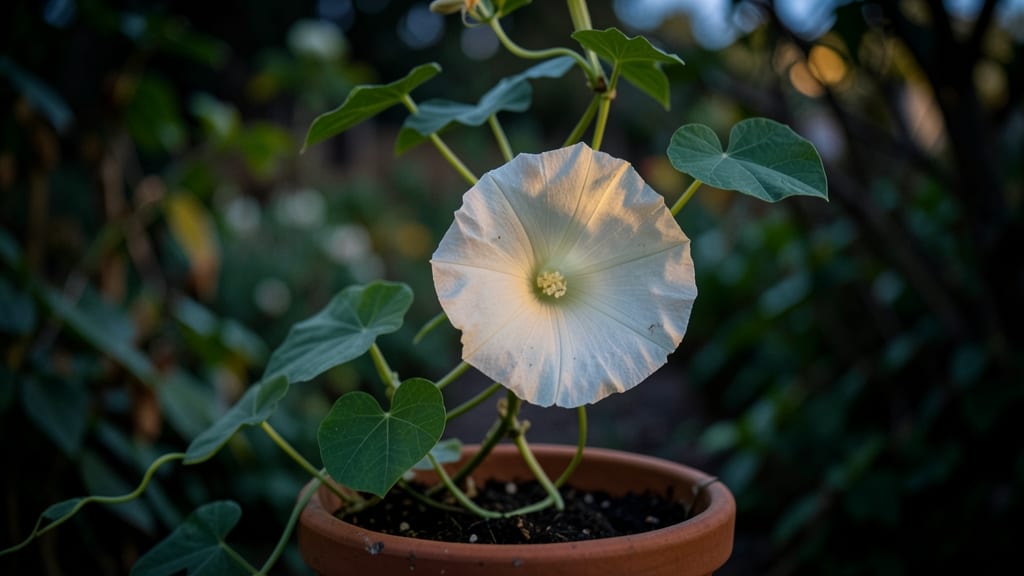
Moon flowers bloom at night in response to darkness, driven by their internal biological clock that activates after sunset. This nighttime opening attracts nocturnal pollinators like moths, maximizing their chances of reproduction. Their brief but stunning display lasts just one evening, requiring precise timing to witness their ephemeral beauty.
This fascinating behavior is called nyctinasty, where plants respond to darkness rather than light. 🌙 Unlike sun-loving flowers, moon flowers have evolved to thrive in low-light conditions, with petals that unfurl dramatically after dusk and close by dawn.
The process is controlled by plant hormones called phytochromes, which detect light levels and trigger the blooming sequence. What's remarkable is how consistently they follow this schedule—even in controlled environments without natural light cycles.
Their nocturnal blooming isn't just about show—it's a clever survival strategy. Many night-flying insects, particularly sphinx moths, are drawn to the moon flower's pale white petals and sweet fragrance that intensifies after dark. This mutual relationship ensures both the plant gets pollinated and the moths find their dinner source.
For gardeners, this means planting moon flowers near other night-blooming plants like evening primrose can create an even more effective pollinator magnet.
💡 In This Article
- The Science Behind Moon Flower’s Nocturnal Blooming Cycle
- Tips for Growing Moon Flowers to Ensure Nighttime Blooms
The science behind moon flower’s nocturnal blooming cycle
Moon flowers (like the moonflower vine Ipomoea alba) rely on a biological process called photoperiodism, where their blooming is triggered by the length of daylight rather than absolute light intensity. Their petals contain specialized cells with phytochrome pigments that detect the shift from light to dark.
When sunlight fades below a critical threshold—typically around 10-12 hours of darkness—these pigments signal the plant's internal clock to initiate blooming. This mechanism is so precise that moon flowers can even synchronize their cycles with artificial lighting, though natural conditions yield the most reliable results.
The actual opening process involves rapid cell elongation in the petal base, fueled by a surge in the hormone ethylene combined with reduced levels of the growth-inhibiting hormone abscisic acid.
Within 30-60 minutes after sunset, the petals unfurl dramatically, revealing their luminous white blooms that reflect moonlight—hence their name. 🌙 What's fascinating is how temperature modulates this: cooler evenings (60-70°F) accelerate blooming, while warmer nights may delay it slightly.
This explains why moon flowers often bloom more prolifically in spring or fall when temperatures are moderate.
This nocturnal strategy isn't unique—it's shared by about 10% of flowering plants, including evening primrose and some orchids. However, moon flowers take it further with their single-night display: their blooms wilt by dawn, a process controlled by rising light levels that trigger abscisic acid production again.
This ephemeral nature ensures energy isn't wasted on flowers that won't get pollinated during daylight hours. The trade-off is that gardeners must be vigilant, as missed evenings mean missed blooms—there's no second chance for that particular flower.
What makes moon flowers particularly efficient is their pollinator specialization. Their pale white petals and sweet, honey-like fragrance (most intense at night) are specifically adapted to attract sphinx moths, which have long proboscises perfect for accessing the flower's nectar deep within.
Studies show these moths can travel up to 3 miles to find night-blooming flowers, making moon flowers an excellent "beacon" for nocturnal pollinators. This mutualistic relationship explains why moon flowers often produce more seeds when planted near other night-bloomers like night-blooming jasmine.
For comparison, consider the evening primrose, which also blooms nocturnally but uses a different strategy: its flowers open wider and remain open longer (up to 24 hours), relying on a broader range of pollinators including bats.
Moon flowers, however, have evolved a more time-sensitive approach, ensuring their energy is spent only when their primary pollinators are active. This precision is what makes their blooming so spectacularly timed—and so fleeting.
Their circadian rhythms are so strong that even when grown indoors under grow lights, moon flowers will attempt to bloom on a 24-hour schedule if the light cycle is consistent. However, without natural temperature fluctuations, their blooms may be less robust.
This highlights how moon flowers have evolved to thrive in their native tropical and subtropical climates, where predictable nighttime cooling triggers their perfect timing.