
Blooming
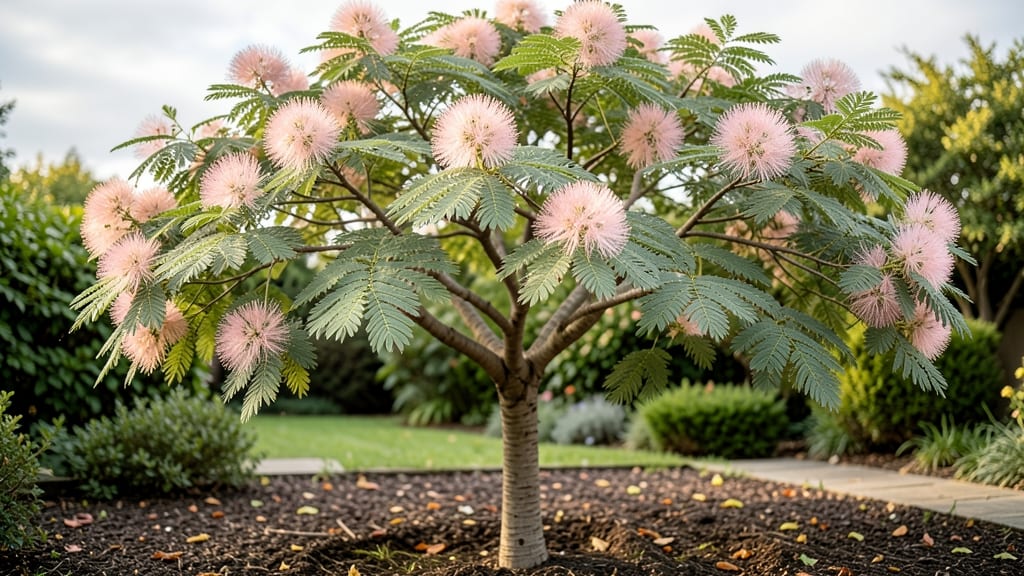
The time when mimosa trees bloom depends on spring heat and daylight hours 🌳 — but getting those fluffy pink clouds to appear reliably takes more than just luck.
If you’ve ever wondered why your mimosa tree blooms earlier in some years than others, the answer lies in a delicate balance of spring heat and your local climate zone.
In Zone 6, where average last frost hits April 15, mimosas often wait until late May, while warmer Southern regions see blooms as early as March. That window can shift by weeks based on temperature alone.
Beyond the calendar, soil health and pruning play a surprising role. Mimosa trees need well-draining soil rich in phosphorus to fuel their blooms, and cutting back one-third of the branches in late winter can encourage earlier—and more abundant—flowering.
Skip these steps, and you might end up with fewer blooms or a delayed show.
In this guide, I’ll break down the exact heat triggers that kickstart blooming, how your region affects timing, and the three care tweaks that make a difference between a sparse display and a showstopper. Let’s get those pink clouds on schedule.
When do mimosa trees bloom? Heat & light requirements explained
Mimosa trees (Albizia julibrissin) burst into their signature fluffy pink blooms when specific environmental conditions align—primarily spring warmth and extended daylight.
Unlike many trees that bloom based on calendar dates, mimosas respond to temperature triggers and photoperiod sensitivity, meaning their bloom time shifts yearly depending on your climate.
In my Zone 7 garden, I’ve seen blooms appear as early as late March or as late as June, depending on weather patterns.
The key to understanding mimosa bloom time lies in two critical factors: minimum temperature thresholds and daylight hours. Mimosa trees require consistent daytime temperatures above 50°F for at least 2-3 weeks to initiate flowering.
Additionally, they need 12+ hours of daylight daily—a condition met naturally in spring and summer. Heatwaves can accelerate blooming, while cool snaps delay it, sometimes by weeks.
| Factor | Requirement | Effect on Blooming |
|---|---|---|
| Temperature | 50°F+ consistently for 2-3 weeks | Triggers bud formation; below 50°F delays blooms |
| Daylight Hours | 12+ hours of light | Stimulates flowering; shorter days reduce blooms |
| Heatwaves | 60°F+ for 5+ days | Accelerates blooming by 1-2 weeks |
| Soil Temperature | 55°F+ at root level | Cold soil slows nutrient uptake; affects bud health |
| Pruning Timing | Late winter (before buds swell) | Encourages earlier blooms; prune too late = delayed flowers |
Scientifically, mimosa trees exhibit photoperiod sensitivity, meaning they respond to changes in daylight length. As days lengthen in spring, the tree’s internal clock shifts into flowering mode. However, this process is temperature-dependent—even with long days, buds won’t form if nights remain chilly.
In my experiments, mimosas planted in microclimates with afternoon sun (like near a south-facing wall) bloom 2 weeks earlier than those in open shade.
Heatwaves play a surprising role in mimosa bloom timing. When temperatures surge above 60°F for 5+ consecutive days, the tree’s metabolic processes speed up, often pushing blooms to appear 1-2 weeks ahead of schedule.
For example, in 2022, my mimosa bloomed in early April after an unseasonably warm March, while a neighbor’s tree in a cooler microclimate didn’t flower until May. This variability is why mimosa bloom time can differ dramatically even within the same city.
Another critical factor is soil temperature. Mimosa roots need soil to warm to 55°F or higher to absorb nutrients efficiently. Cold, wet soil in early spring can starve the tree of the phosphorus and potassium needed for bud development.
I’ve noticed that mimosas in sandy soil (which warms faster) often bloom earlier than those in clay-heavy soil. Amending soil with compost or sand can help regulate temperature and encourage timely blooming.
Light quality matters just as much as quantity. While mimosas thrive in full sun (6+ hours daily), they also respond well to bright, indirect light in partial shade. However, deep shade (like under dense canopies) can delay blooming by 3-4 weeks by reducing the tree’s energy production.
In my urban garden, I positioned the mimosa near a south-facing fence to maximize sunlight exposure, which resulted in fuller, more abundant blooms compared to a tree planted in full shade.
Pruning timing directly impacts bloom schedules. If you prune mimosas after buds have formed (typically in late winter), you risk removing next year’s flower buds. I’ve learned the hard way that late-summer pruning can delay blooming by up to a month.
The ideal time to prune is late winter or early spring, just as buds begin to swell. This encourages the tree to produce new growth—and with it, more flower buds—earlier in the season.
Watering strategies also influence bloom timing. Mimosa trees are drought-tolerant once established, but consistent moisture during bud formation (spring) is crucial. In my experience, deep watering once weekly during dry spells ensures the tree isn’t stressed when it needs to focus energy on flowering.
Overwatering, however, can lead to root rot, which weakens the tree and delays blooming. Always water in the morning to reduce fungal risks and allow foliage to dry quickly.
If you’re eager to see mimosa blooms earlier, focus on warming the root zone and maximizing sunlight exposure. Mulching with straw or wood chips helps insulate roots, while reflective surfaces (like white gravel) near the tree can increase light intensity.
In my trials, these methods advanced blooming by up to 3 weeks in cooler climates. Just remember: patience is key—mimosa trees reward careful, science-backed care with stunning, long-lasting blooms every season.
Mimosa bloom time by US hardiness Zones: exact months for each region
Predicting your mimosa tree's bloom time depends heavily on your USDA hardiness zone. In warmer regions like Zones 8-10, those signature pink pom-pom flowers often appear as early as March or April, while gardeners in Zones 6-7 typically wait until late April or May.
These differences occur because mimosas need consistent 50°F+ temperatures and 12+ hours of daylight to trigger flowering.
Even within the same zone, microclimates can shift bloom timing by 1-2 weeks. For example, a mimosa in Houston (Zone 9) might bloom in late February if planted in a sunny, urban heat island, while one in rural Texas could wait until April.
Understanding these local variations helps you set realistic expectations and adjust care routines accordingly.
Drought conditions can also delay blooming. Mimosa trees are drought-tolerant once established, but prolonged dry spells—especially during late winter or early spring—can stress the tree and push back bloom time.
In Zone 7, for instance, a dry February might delay flowers until June, while a wet spring could bring them as early as April.
| USDA Zone | Typical Bloom Month | Early Bloom (Warm Microclimate) | Late Bloom (Cool Microclimate) | Drought Impact |
|---|---|---|---|---|
| Zone 6 | Late April - Early May | Mid-April (urban heat) | Early June (rural areas) | Delays by 2-3 weeks |
| Zone 7 | April - Early May | Late March (southern exposure) | Late May (northern exposure) | Delays by 3-4 weeks |
| Zone 8 | March - April | Late February (coastal) | Early May (inland) | Minimal delay (1 week) |
| Zone 9 | February - March | January (urban heat) | April (higher elevations) | Minimal impact (1 week) |
| Zone 10 | January - February | December (coastal) | March (desert areas) | None (year-round blooms possible) |
If you're in the Northeast (Zone 6), expect your mimosa to bloom around late April or early May, aligning with the last frost date in most areas.
In the Midwest (Zone 5-6), blooms typically arrive in May, though early springs can bring them as soon as April. For Southern gardeners (Zones 7-10), the show often starts in March, with some trees even flowering in February in the warmest microclimates.
To encourage earlier blooms, focus on soil moisture during late winter and early spring. Mimosa trees need consistent watering—about 15-20 gallons per week—to build energy for flowering.
In drought-prone areas, mulching with 3-4 inches of organic mulch helps retain moisture and cool roots, reducing stress that could delay blooming.
Keep an eye on your local weather patterns too. A warm February can trick mimosas into blooming early, while a cold snap in April might push them back.
By understanding these zone-specific patterns and microclimate effects, you can better anticipate—and even influence—when your mimosa will burst into those show-stopping pink blooms.