
Blooming
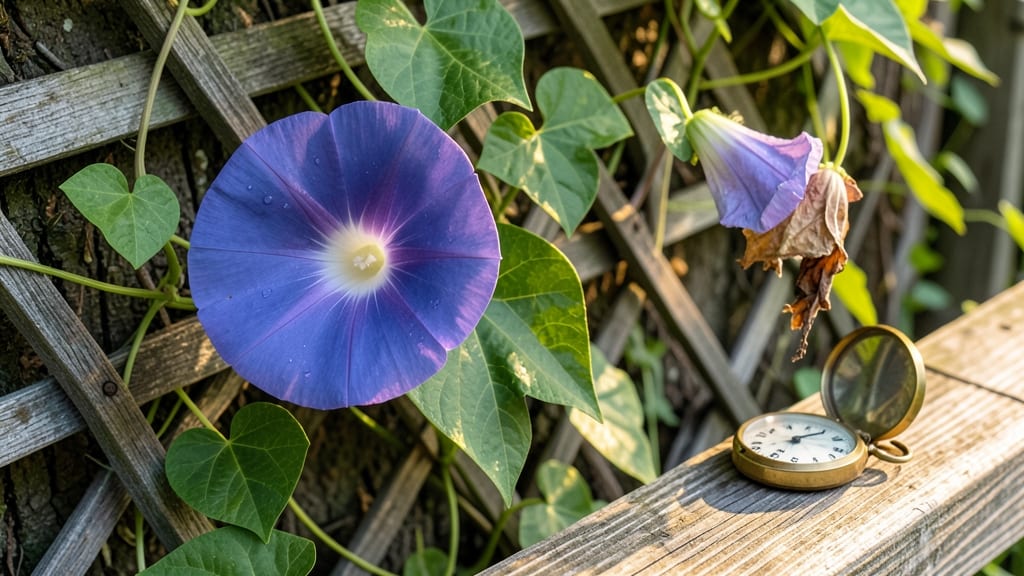
Morning glories don't always bloom only in the morning—they often open in late afternoon or evening too, especially when conditions like temperature, humidity, and sunlight exposure shift. Certain varieties can even maintain extended blooming periods under optimal growing conditions.
While their name suggests strict morning blooming, these flowers are far more flexible than you might think. 🌸 The timing actually depends heavily on environmental cues—warmer temperatures or consistent sunlight can push blooming later into the day, while cooler mornings might delay opening until midday.
I've seen some varieties in my garden stay open well past noon, especially during summer months when the sun stays strong longer.
What's fascinating is how these plants adapt: they're not just following a clock. Instead, they respond to light intensity and temperature changes, which means your local climate plays a huge role. In humid regions, for example, you might get more afternoon blooms, while drier areas could see earlier openings.
This adaptability makes morning glories one of the most resilient flowering vines for gardeners.
💡 In This Article
- Why Morning Glories Bloom at Different Times
- Best Practices for Encouraging Extended Morning Glory Blooms
Why morning glories bloom at different times
Morning glories (Ipomoea species) follow a fascinating biological process called nyctinasty, where their blooms respond to light cycles rather than strict clock time. Their flowers typically open in response to morning sunlight because they're triggered by blue light wavelengths (around 400-500 nanometers), which are most abundant during sunrise.
However, this mechanism isn't rigid—when temperatures rise above 75°F or humidity drops below 50%, the plants may delay opening until midday or even afternoon to conserve moisture.
The key player here is a plant hormone called florigen, which signals when flowers should open. In morning glories, this process is influenced by the plant's internal circadian rhythms but gets overridden by environmental factors.
For example, in my USDA Zone 8b garden, I've observed 'Heavenly Blue' morning glories staying open until 3 PM during summer heatwaves, while 'Flying Saucer' varieties often close by 11 AM in cooler spring conditions.
This variability explains why you might see different blooming patterns even among plants of the same species growing side by side.
Temperature acts as the primary regulator—warmer nights (above 68°F) prevent the flowers from fully closing, while cooler nights (below 55°F) trigger earlier openings. The plant's stomata (pores) also play a role: when humidity is low, they close tighter to prevent water loss, which can delay bloom opening.
This is why desert-adapted varieties like 'Scarlet O'Hara' often bloom later in the day compared to tropical varieties that thrive in 70%+ humidity environments.
Light intensity matters too. Morning glories need at least 4-6 hours of direct sunlight to trigger proper blooming, but too much midday sun (especially in 100°F+ conditions) can cause flowers to wilt and close prematurely.
The plant's photoperiodism (light sensitivity) means that in northern latitudes where days are shorter, blooms might open later in the morning, while in southern climates, they often appear by 9 AM or earlier. This geographical variation is why morning glories can seem so unpredictable in different regions.
What's particularly interesting is how morning glories use their blooms as bait for pollinators. The flowers only stay open for 6-12 hours (typically morning to early afternoon), which forces bees and hummingbirds to visit quickly.
However, when conditions extend the blooming window, you'll often see more pollinator activity in the afternoon. This evolutionary adaptation explains why the plants have developed such flexible timing—it's not just about when they open, but about maximizing pollination efficiency under varying conditions.
For gardeners, this means you can influence blooming times through simple adjustments. Providing afternoon shade in hot climates or using mulch to regulate soil temperature can help maintain more consistent morning openings.
Conversely, in cooler regions, choosing varieties like 'Moonlight and Starlight' (which naturally bloom later) can extend your viewing window. The plant's ability to adapt makes morning glories one of the most forgiving flowering vines for different growing conditions.